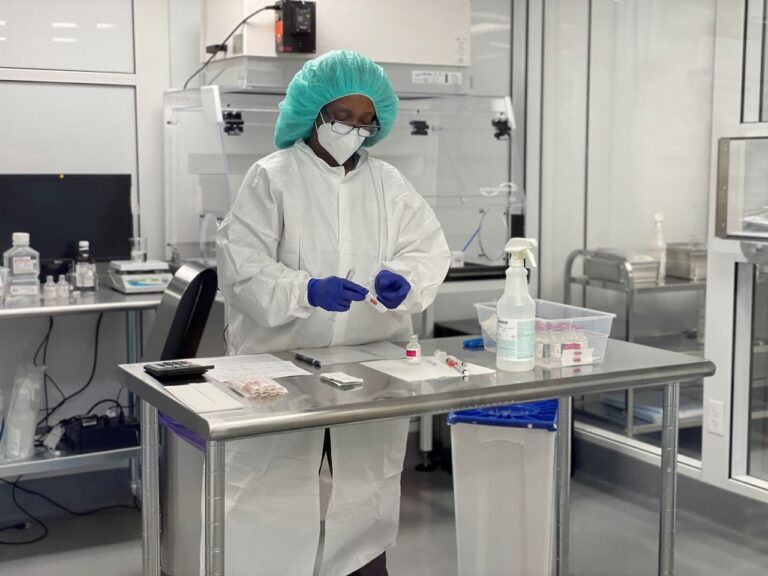

Short Answer: Check three things before anything else: that the pharmacy holds a current licence with your state board, that it is accredited for the type of compounding you need, and that a pharmacist will actually speak to you about your prescription. Everything else, price, turnaround, delivery, matters, but only after those three.
Compounded medications are not FDA-approved. That is not a scandal and it does not mean they are unsafe, it is simply how the category works, because a medication made for one patient cannot go through the approval process built for mass-produced drugs.
What it does mean is that the quality of a compounded medication depends almost entirely on the pharmacy that makes it. With a commercially manufactured drug, the brand on the box carries the quality assurance. With a compounded one, the pharmacy is the quality assurance. That is why choosing well matters more here than it does at a regular retail counter. Learn more about how compounding works at MedFront Pharmacy.
Here is what to check.
1. Is the pharmacy licensed, and can you confirm it yourself?
Every pharmacy must hold a current licence with the board of pharmacy in the state where it operates. A pharmacy shipping into another state usually needs a non-resident licence there as well.
You do not have to take anyone’s word for this. The Texas State Board of Pharmacy publishes a public licence verification search at pharmacy.texas.gov. Search the pharmacy’s name, confirm the licence is current, and check whether any disciplinary action is listed. It takes about a minute.
If you are outside Texas, your own state board runs an equivalent search. If a pharmacy’s licence does not appear, or the status is anything other than current and active, stop there.
2. Is it accredited, and for the right thing?
Accreditation is voluntary, which is exactly what makes it meaningful. A pharmacy that has sought it has chosen to have its processes inspected against published standards by an outside body.
The main one in the United States is PCAB accreditation, run by the Accreditation Commission for Health Care. It confirms compliance with the USP compounding standards, and it comes in distinct categories:
| Accreditation | Covers | Standard |
|---|---|---|
| PCAB non-sterile (CFNS) | Creams, capsules, oral liquids, troches | USP <795> |
| PCAB sterile (CFST) | Injectables, eye drops, anything sterile | USP <797> |
| Hazardous drugs (HDPCAB) | Hazardous preparations, an add-on, never standalone | USP <800> |
The distinction matters. A pharmacy accredited for non-sterile compounding is not thereby accredited for sterile work, and sterile preparation is where the risk is highest. If your prescription is an injectable or an ophthalmic preparation, ask specifically about sterile accreditation rather than accreditation in general.
ACHC publishes a searchable directory of accredited organisations, so this is another claim you can verify rather than accept.
| One thing worth knowing A non-resident inspection by a state board is not the same as accreditation. Some pharmacies present one as though it were the other. They are different processes with different standards behind them. |
|---|
3. Do you need a 503A pharmacy or a 503B facility?
These two labels come from the Federal Food, Drug, and Cosmetic Act, and the difference is simpler than it sounds.
| 503A compounding pharmacy | 503B outsourcing facility | |
|---|---|---|
| Compounds for | An identified individual patient, on a valid prescription | May compound without patient-specific prescriptions |
| Registers with FDA | Not as an outsourcing facility | Yes, under section 503B(b) |
| CGMP requirements | Exempt | Not exempt |
| Typically serves | Patients and prescribers | Hospitals, clinics, facilities buying in bulk |
For a patient filling a personal prescription, a 503A pharmacy is the normal and appropriate route. You do not need a 503B facility, and a pharmacy that is one is generally not set up to serve you directly.
Where this matters is if you are a prescriber or a clinic buying office stock. That is 503B territory, and the distinction is a legal one rather than a preference.
4. Does it compound your specific medication regularly?
This is the question most patients do not think to ask, and it is one of the more useful ones.
Compounding is a skill, and it is a different skill for each preparation. A pharmacy that prepares hormone capsules every day is not automatically good at ophthalmic preparations or at pediatric suspensions. Ask how often they make what you have been prescribed.
A straight answer is a good sign. Vagueness about something they supposedly do routinely is not.
5. Will a pharmacist actually talk to you?
Call before you commit and ask a real question about your prescription. How quickly do you reach a pharmacist rather than a queue? Do they explain things clearly, or deflect? You can also review MedFront’s prescription services to see how pharmacist support fits into prescription care.
Compounded medications tend to come with more questions than commercial ones, how to store it, how long it lasts, what to do if it separates, whether the strength can be adjusted. If getting answers is difficult before you are a customer, it will not get easier afterwards.
This is also the point at which you can tell whether a pharmacy will speak to your prescriber directly. The good ones offer; it saves everyone a round of phone tag.
6. How does it handle ingredients and testing?
Reasonable questions, and ones a good pharmacy will answer without hesitation:
- Where do the active ingredients come from, and are they from FDA-registered suppliers?
- Is finished-product testing done, and on what, potency, sterility, both?
- How is a beyond-use date determined for my preparation?
- What happens if a batch does not meet specification?
You are not expected to audit anybody. You are listening for whether the answers are specific and confident, or improvised.
7. What are the practical terms?
Worth settling before you hand over a prescription rather than after.
| Ask about | Why it matters |
|---|---|
| Turnaround time | Compounding is not instant, most preparations take days, not minutes |
| Refill process | Whether reordering needs a new prescription each time |
| Shipping and storage | Temperature-sensitive preparations need cold-chain handling |
| Prescriber coordination | Whether they will contact your doctor directly about formulation |
| Cost before you commit | You should get a clear figure, not a surprise at collection |
| Insurance | Many compounded medications are not covered, ask upfront |
On insurance specifically: coverage for compounded medications is inconsistent, and a pharmacy that tells you plainly that something is unlikely to be covered is being straight with you, not unhelpful. Ask whether they can supply the paperwork for a reimbursement claim even when they cannot bill directly. MedFront also answers common questions about compounding, insurance, and pharmacy services.
8. What should make you walk away?
Most compounding pharmacies are careful operations run by people who take the work seriously. A few are not. These are the signals worth acting on.
| Red flag | Why it matters |
|---|---|
| No prescription required | Compounded medications are prescription-only. This is not a shortcut, it is illegal |
| Licence not verifiable | If it does not appear on the state board search, something is wrong |
| Claims of being FDA-approved | Compounded medications are not FDA-approved. Any pharmacy saying otherwise is misinformed or misleading you |
| Promises of superior results | No pharmacy can promise a compounded version works better than a commercial one |
| Pressure to buy larger quantities | Compounded preparations have limited beyond-use dates |
| No pharmacist available to speak to | You should always be able to reach one |
| Marketing a condition rather than filling a prescription | A pharmacy’s job is to prepare what your prescriber ordered |
| Vague about where ingredients come from | A reasonable question with a reasonable answer |
Local or mail order?
Both are legitimate, and the honest answer is that it depends on the preparation.
Mail order makes sense when a pharmacy has particular expertise in something unusual, or when nothing nearby compounds what you need. Plenty of excellent compounding pharmacies ship across state lines under non-resident licences.
Local tends to win on anything time-sensitive, anything that needs refrigeration, anything where you are likely to need adjustments, and anything for a child, where being able to walk in and ask about a dosing problem is worth a great deal.
If you do use a mail-order pharmacy, confirm it holds a non-resident licence in your state, and ask how temperature-sensitive items are shipped. For MedFront’s available shipping and delivery options, see the pharmacy contact page.
Questions worth asking on the first call
- Are you licensed in my state, and what is your licence number?
- Are you PCAB accredited, and for sterile or non-sterile compounding?
- How often do you prepare this specific medication?
- Where do your active ingredients come from?
- Do you test finished preparations?
- How long will this take, and what will it cost?
- Will you speak to my prescriber directly if the formulation needs adjusting?
- Who do I call if something seems wrong with it?
Any pharmacy worth using will answer all eight without becoming defensive.
How MedFront fits
We are a compounding pharmacy in Dallas and across Texas, preparing medications to prescriber specification, custom strengths, alternative dosage forms, allergen-free and dye-free preparations, and formulations for patients who cannot take what is commercially available.
[CREDENTIALS PARAGRAPH, licence number, accreditation status and years in operation to be supplied and verified by the client before publishing.]
If you have been prescribed something compounded and are deciding where to fill it, contact the MedFront Pharmacy team. If what you need is outside what we do well, we will tell you and point you somewhere that does it better.
| Worth remembering Compounded medications are not FDA-approved and are prepared on a prescriber’s order for an individual patient. A good pharmacy will be clear about that rather than implying otherwise. |
|---|
Frequently asked questions
How do I know if a compounding pharmacy is legitimate?
Verify its licence on your state board of pharmacy’s public search, in Texas, at pharmacy.texas.gov. Check for accreditation in the ACHC directory. Confirm a pharmacist is reachable by phone. A pharmacy that is hard to verify is one to avoid.
Are compounded medications FDA-approved?
No. Compounded medications are not FDA-approved, because they are prepared for individual patients rather than mass-produced. Quality depends on the pharmacy, which is why licensing and accreditation matter.
What does PCAB accreditation mean?
PCAB accreditation is run by the Accreditation Commission for Health Care and confirms a pharmacy complies with the USP compounding standards. It is voluntary and comes in separate categories for non-sterile, sterile and hazardous compounding.
What is the difference between 503A and 503B?
A 503A compounding pharmacy prepares medications for identified individual patients on a valid prescription. A 503B outsourcing facility registers with the FDA and may compound without patient-specific prescriptions, typically supplying hospitals and clinics in bulk.
Which one do I need as a patient?
A 503A compounding pharmacy. That is the normal route for a personal prescription. 503B facilities generally supply institutions rather than individuals.
Do I need a prescription for a compounded medication?
Yes, always. Any pharmacy offering compounded medications without a prescription is operating illegally.
Does insurance cover compounded medications?
Often not, and coverage is inconsistent between plans. Ask the pharmacy upfront what the cost will be and whether they can supply paperwork for a reimbursement claim.
How long does compounding take?
Usually days rather than minutes, depending on the preparation. Ask for a timeframe when you drop off the prescription so you can plan refills before you run out.
Is a compounded medication as good as a commercial one?
It is different rather than better. Compounding exists to solve problems commercial products cannot, an allergy to an inactive ingredient, a strength that does not exist, a form a patient cannot take. No pharmacy should promise superior results.
Can a compounding pharmacy copy a commercial drug?
Generally no. Compounding is not intended to reproduce commercially available medications, and there are specific federal restrictions on preparing what is essentially a copy of an approved drug.
Is a local pharmacy better than mail order?
Neither is automatically better. Local is usually preferable for refrigerated preparations, time-sensitive medications, children’s medications and anything needing adjustment. Mail order makes sense for specialised preparations not available nearby.
What is USP 795 and 797?
They are the United States Pharmacopeia standards for compounding. USP <795> covers non-sterile preparations, USP <797> covers sterile ones, and USP <800> covers hazardous drugs. PCAB accreditation assesses compliance with them.
What should I do if something seems wrong with my medication?
Stop using it and call the pharmacy immediately, changes in colour, smell, separation or texture are worth reporting. A good pharmacy will want to know and will replace it if there is a problem.
Can my doctor recommend a compounding pharmacy?
Usually, and it is a reasonable place to start. Still run the licence and accreditation checks yourself, since a recommendation is not a verification.