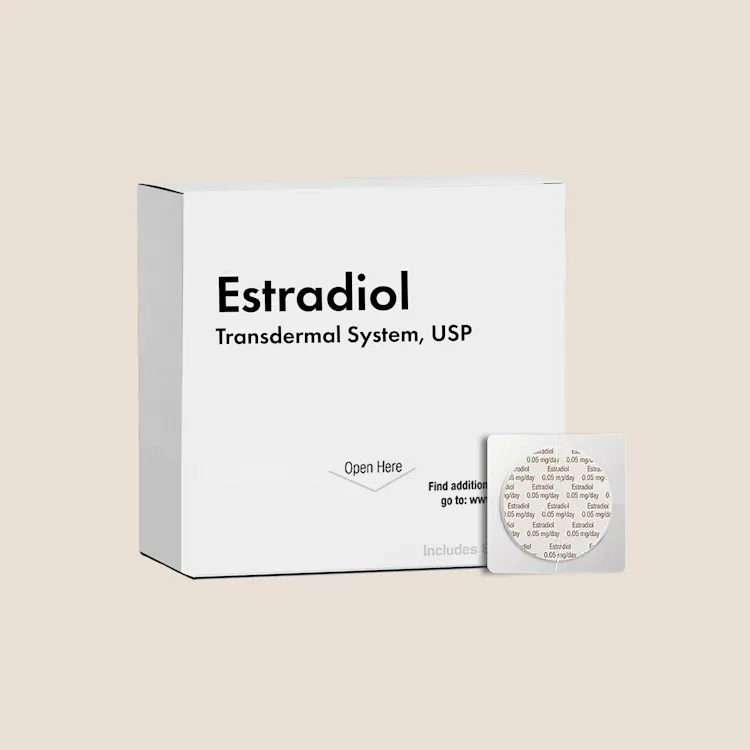
If your pharmacy has told you your estradiol patch is on back order, you are not being singled out and you have not done anything wrong. Patches have been difficult to get across the United States for most of 2026, and the problem has since spread to injectable estradiol and estradiol vaginal creams. This article explains what is happening, the approved alternatives worth asking your prescriber about, and the narrower question of where a compounding pharmacy legitimately fits, including when it does not.
The Short Answer
Estradiol patches are in tight supply because demand rose sharply after the FDA began removing the boxed warnings from menopausal hormone therapy in November 2025, and manufacturing has not caught up. Your fastest route is usually not to hunt for the same patch, but to call your prescriber and ask about a different manufacturer, a different strength combination, or a different approved dosage form: gel, spray, oral, or a vaginal ring. Compounding is a real option, but it is a clinical decision your prescriber makes and documents, not a workaround for a supply problem.
Why Is There an Estradiol Patch Shortage?
Two things happened in sequence.
On 10 November 2025, the US Department of Health and Human Services and the FDA announced they had begun removing the boxed warnings, the black-box warnings, from menopausal hormone therapy products. The warnings being removed cover cardiovascular disease, breast cancer and probable dementia. FDA Commissioner Marty Makary framed the decision this way: “Women and their physicians should make decisions based on data, not fear.” The same announcement included approval of a generic conjugated estrogens product and a non-hormonal treatment for moderate to severe hot flashes.
Demand followed. Mark Cuban’s Cost Plus Drugs told Reuters that demand rose roughly five to ten times. Viatris, one of the largest patch manufacturers, reported a significant surge, moved its plant in St Albans, Vermont to around-the-clock production and began adding a production line. The FDA said in September 2026 that the US supply of approved patches had nearly doubled over the prior year and still had not kept up.
Then came the knock-on effect. Dr Kathleen Jordan of Midi Health described it to Reuters as a domino effect: patients who could not get patches moved to gels and creams, and those products came under pressure in turn. By early September 2026, injectable estradiol and estradiol vaginal creams were appearing on shortage listings of their own. Kevin Schipper of ProPharma noted that the pattern does not look like a broad shortage of raw materials, it looks like demand moving from one dosage form to the next.
Estradiol Shortage Timeline
| When | What happened |
| 10 Nov 2025 | FDA and HHS begin removing boxed warnings for cardiovascular disease, breast cancer and probable dementia from menopausal hormone therapy products |
| 30 Jan 2026 | ASHP begins tracking an estradiol transdermal system shortage |
| Aug 2026 | ASHP’s update lists affected packages across five manufacturers, with products variously on back order, intermittent back order or allocation |
| 3 Sept 2026 | FDA states patients are having difficulty readily accessing their usual patches, but that patches remain available nationally |
| Early Sept 2026 | Injectable estradiol appears on shortage listings; estradiol vaginal creams listed as back-ordered or on allocation |
| Sept 2026 onward | FDA works with manufacturers to increase supply |
| 28 Oct 2026 | Reuters reports the supply crunch has widened beyond patches |
Why Does the FDA Say Patches Are Available When My Pharmacist Says There’s a Shortage?
This is the part almost nobody explains, and it is worth understanding because it affects what your pharmacy is allowed to do.
Two different organisations track drug supply, and they use different thresholds.
FDA Drug Shortage Database vs. ASHP Shortage List
| FDA drug shortage database | ASHP shortage list | |
| Who runs it | The federal regulator | The American Society of Health-System Pharmacists, a professional body |
| What it measures | Whether national supply meets national demand | Whether every manufacturer has every strength and package size in stock |
| Estradiol patches | Not listed as a shortage. FDA has described patients having difficulty readily accessing their usual patches, while stating patches remain available | Listed since 30 January 2026, with affected packages across several manufacturers |
Both are accurate descriptions of different things. Nationally, estradiol patches are being made and shipped. Locally, the specific patch, strength and brand on your prescription may be unavailable for weeks. That gap is where you are standing.
It also matters legally. A compounding pharmacy ‘s ability to prepare its own version of a commercially available medication is restricted, the rule exists so that compounders do not simply duplicate approved products. Drugs on the FDA shortage list are treated differently, because the FDA does not consider a drug on that list to be commercially available. Estradiol patches are not on that list. So the shortage, by itself, does not open a door. What opens a door is a prescriber deciding, and documenting, that this particular patient needs something the market does not supply.
What Should I Do First?
In this order.
- Call your prescriber’s office before you run out, not after. Give yourself at least a week. Most of the available solutions need a new or amended prescription, and that takes time to arrange.
- Ask whether a different manufacturer’s patch is available. Not every brand and generic is affected equally. At the time of writing, some once-weekly patches were reported as available in all strengths while several twice-weekly generics were constrained. Your pharmacist can check what is actually obtainable today, which is more current than any article.
- Ask whether a different strength combination would work. Your prescriber may be able to reach your dose a different way using strengths that are in stock. Do not work this out yourself and do not cut or re-use patches, the dose delivered by a transdermal patch is not proportional to its surface area in the way people assume.
- Ask about a different approved dosage form. There are several, and for most people one of them is a reasonable substitute. The table below is a prompt sheet for that conversation.
- Ask your pharmacy to check supply before the prescription is sent. A prescription for something equally unobtainable costs you another week.
- If none of the approved options fit you, ask your prescriber whether a compounded preparation is clinically appropriate. That is the point at which a compounding pharmacy becomes relevant.
Do Not Stop Abruptly and Do Not Stretch Your Supply
Cutting patches in half, wearing one for longer than prescribed, or skipping days to make a box last are all common responses to a shortage and none of them are good ideas. If you are running out, say so to your prescriber and your pharmacist, that is a problem both of them would rather solve in advance.
What Can I Use Instead of an Estradiol Patch?
All of the following are FDA-approved dosage forms. Which one suits you depends on your symptoms, your medical history, your skin, your insurance and what is in stock, which is why this is a conversation rather than a choice from a list.
FDA-Approved Estradiol Alternatives
| Approved form | How it is used | Worth knowing |
| Transdermal gel | Applied daily to the arm or thigh | Came under supply pressure as patients moved across from patches. Transfer to others by skin contact is a real consideration, follow the application and washing instructions |
| Transdermal spray | Applied daily to the forearm | Same transfer consideration as gel |
| Transdermal emulsion | Applied daily to the legs | Less widely stocked; worth asking about |
| Oral tablet | Taken daily | Goes through the liver first, unlike the skin routes. That difference matters for some medical histories, so it is a prescriber decision rather than an equivalent swap |
| Vaginal ring | Inserted and replaced on a schedule | Some rings treat local symptoms only, others deliver a systemic dose. These are not interchangeable, be clear which one is being discussed |
| Vaginal cream or tablet | Used locally on a tapering schedule | Primarily for genitourinary symptoms rather than hot flushes. Creams were themselves on shortage listings in late 2026 |
| Injection | Given at intervals by a clinician or self-administered | Was itself reported in shortage in September 2026 |
Where Does a Compounding Pharmacy Actually Fit?
Honestly: more narrowly than most marketing suggests, and that narrowness is worth respecting.
The major professional bodies are consistent on this. The Endocrine Society’s position statement is blunt, there is no evidence-based medical need for compounded hormone therapy when an FDA-approved product is available, and prescribers should exercise caution when prescribing it. The reason is not snobbery about compounding. It is that compounded preparations are not reviewed by the FDA for dose, purity, safety or efficacy before they reach you, and surveys of compounded hormone products have found inconsistencies in dose and quality. The Endocrine Society puts it plainly: there may be additional and at this point unknown risks associated with them.
So the question is not “can a pharmacy make estradiol?” It is “is there a reason this patient cannot use an approved product?” There are real answers to that question:
- A documented allergy or sensitivity to an ingredient in the approved products, most often the adhesive in a patch, which is a genuinely common problem and a genuinely good reason
- A dose that is not manufactured, where the prescriber has determined that an available strength is not clinically suitable
- A dosage form that does not exist commercially for the combination the patient needs
- An inability to use any available form for a documented clinical reason
What is not on that list is convenience, price, or a preference for something described as more natural. A supply problem where an approved alternative exists is a conversation with your prescriber about switching forms, not an automatic case for compounding.
If your prescriber does decide a compounded preparation is appropriate, they write a patient-specific prescription for it, and a licensed compounding pharmacy prepares it to that prescription. That is the whole mechanism. There is no route in which a patient arranges it directly.
The Word “Bioidentical” Is Doing Less Work Than You Think
Bioidentical means the molecule is the same as the one your body makes. It is not a regulatory category and it does not mean compounded. Estradiol and micronized progesterone are both bioidentical and both available as FDA-approved products that have been through clinical trials and are made under manufacturing oversight. If a clinic implies that bioidentical hormones are only available compounded, that is marketing, not pharmacology.
For more information about hormone therapy, you can explore MedFront’s dedicated hormone therapy page.
The One Safety Point Not to Skip
The November 2025 announcement removed three boxed warnings. It did not remove all of them. The boxed warning about endometrial cancer on systemic estrogen-alone products stayed in place, and it stayed for a good reason.
If you have a uterus and you are taking systemic estrogen, you also need adequate progestogen to protect the lining of the uterus. This is not optional and it does not change because there is a shortage. If a supply problem has disrupted your regimen, if you have run out of one component, or switched forms, or stopped and restarted, raise it specifically with your prescriber so both halves of your therapy are reviewed together. A shortage is exactly the kind of disruption that causes half a regimen to quietly go missing.
Unscheduled bleeding on hormone therapy is always worth a same-week call to your prescriber, shortage or no shortage.
How Long Will the Shortage Last?
Nobody has given a date, and anyone who offers you one is guessing. What is known is that manufacturers have added capacity, Viatris moved a plant to continuous production and is adding a line, and that the FDA has been working with manufacturers to increase supply since September 2026. Supply has been improving while demand has kept climbing, which is why the shortage has persisted even as production rose. Because the pressure is spreading between dosage forms rather than easing uniformly, the sensible planning assumption is that availability of any single product will stay unpredictable for a while yet.
The practical implication: request refills earlier than you used to, and do not wait until the last patch to find out whether the next box exists.
How MedFront Can Help
We are an independent compounding pharmacy in Dallas, and there are three useful things we can do.
- Tell you what is actually obtainable right now. Supply changes weekly and varies by product. One phone call is faster than reading anything, including this page.
- Talk to your prescriber directly. Most of what resolves a shortage is a change to the prescription, and prescribers are generally glad to have a pharmacist tell them what is in stock before they write it.
- Prepare a compounded preparation when your prescriber determines one is clinically necessary and writes for it, for a patch adhesive allergy, for instance, or a strength that is not manufactured.
If you are a prescriber trying to keep patients on therapy through this, we are happy to be the pharmacy you call before writing. Our provider line is the fastest route.
Frequently Asked Questions
Is Estradiol Officially on the FDA Shortage List?
Estradiol transdermal patches are not listed in the FDA’s drug shortage database. The FDA has described patients having difficulty readily accessing their usual patches while stating that patches remain available nationally. ASHP, the professional pharmacists’ body, has listed an estradiol transdermal shortage since 30 January 2026 because it tracks whether every manufacturer has every package in stock. Both are correct about different things.
Why Did the Shortage Start?
Demand for menopausal hormone therapy rose sharply after the FDA began removing boxed warnings from these products on 10 November 2025, and manufacturing capacity has not caught up. The FDA said in September 2026 that patch supply had nearly doubled year over year and still had not met demand.
Can a Compounding Pharmacy Just Make My Patch?
No, and it is worth knowing why. Compounded transdermal patches are not something a 503A pharmacy prepares, patches are a manufactured delivery system. What a compounding pharmacy can prepare, on a prescription, is a different dosage form such as a cream or gel. Whether that is appropriate for you is your prescriber’s decision.
Is Compounded Estradiol as Good as the Patch?
It has not been tested the way approved products have. Compounded preparations do not go through FDA review for dose, purity, safety or efficacy, and the Endocrine Society’s position is that there is no evidence-based medical need for compounded hormone therapy when an approved product is available. That is why it is reserved for patients who have a documented reason they cannot use an approved product.
Can I Cut My Patches in Half to Make Them Last?
Don’t, unless your prescriber has specifically told you to. The dose a patch delivers is not simply proportional to its size, and different patch designs behave very differently when cut. If you are running short, call your prescriber instead.
What If I’m Allergic to the Patch Adhesive?
That is one of the clearest legitimate reasons for a compounded preparation, and it is more common than people expect. Tell your prescriber specifically that the reaction is to the adhesive rather than to the hormone, because it changes what they can prescribe.
Will My Insurance Cover a Different Dosage Form?
Often yes, but coverage varies by plan and some forms need prior authorisation. Ask the pharmacy to check your benefit before the prescription is written rather than after, so you are not choosing between two things you cannot afford.
Will Insurance Cover a Compounded Version?
Usually not in full, and sometimes not at all. Compounded preparations are handled differently by pharmacy benefits than manufactured products. Ask for the cash price up front so there are no surprises.
Is It Dangerous to Miss a Few Days of Estrogen?
Missing doses generally brings symptoms back rather than causing harm, though some people feel the swing sharply. The more important issue is the pattern: repeated gaps make it hard for your prescriber to tell whether your dose is right. Tell them it happened.
I Have a Uterus and I Ran Out of My Progesterone, Not My Estrogen. Does That Matter?
Yes, and this one needs a call rather than a wait. If you have a uterus and you are taking systemic estrogen, adequate progestogen protects the lining of the uterus. The FDA kept the boxed warning about endometrial cancer on systemic estrogen-alone products for this reason. Do not continue estrogen alone while you wait for the other half.
Are the Boxed Warnings Really Gone?
Three of them are being removed, cardiovascular disease, breast cancer and probable dementia, and the FDA is updating labels with manufacturers, so the change is rolling rather than instant. The boxed warning about endometrial cancer on systemic estrogen-alone products remains.
Does “Bioidentical” Mean Compounded?
No. Bioidentical describes the molecule, not how it was made. Estradiol and micronized progesterone are both bioidentical and both available as FDA-approved products.
Should I Buy Estradiol Online From Overseas?
No. Products bought outside the regulated supply chain have no verified identity, strength or purity, and you have no recourse if something is wrong. A shortage is a reason to talk to your prescriber, not to leave the system.
How Do I Get This Started With MedFront?
Call us with the prescription you currently hold and tell us what you have been unable to fill. We will tell you what is obtainable, and if a change is needed we will speak to your prescriber. If a compounded preparation turns out to be appropriate, your prescriber writes for it and we prepare it. You can contact our pharmacy team to get started.