
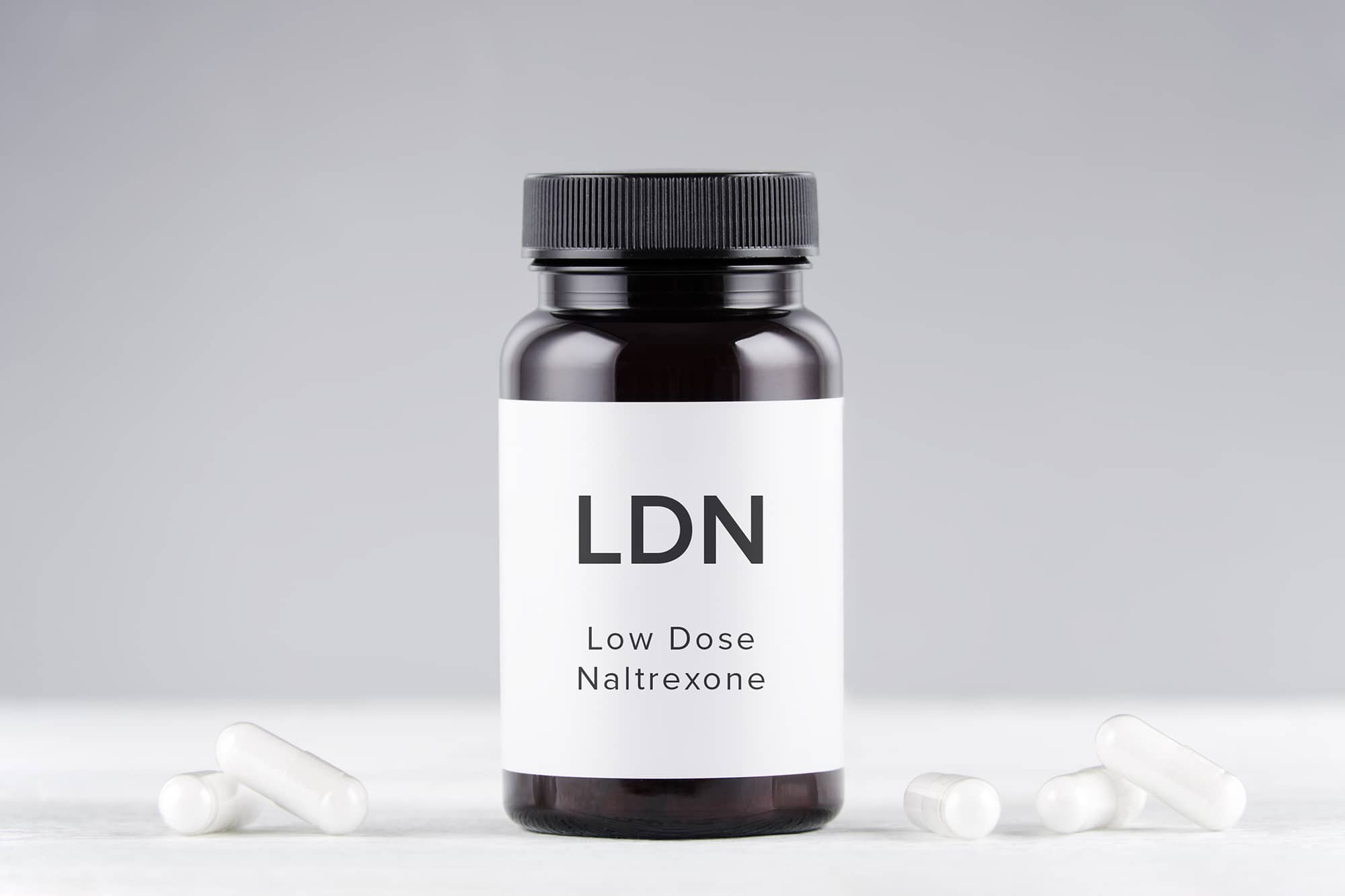
Short answer: Low dose naltrexone is the same drug used to treat opioid and alcohol dependence, prescribed at roughly a twentieth of the usual dose commonly 1.5 to 4.5 mg instead of 50 mg. At that dose it appears to act on inflammatory signalling rather than on opioid receptors. It is prescribed off-label, it is not FDA-approved for any of the conditions it is used in, and the evidence is genuinely mixed: reasonably encouraging in fibromyalgia, weaker in Crohn’s disease, and inconsistent in multiple sclerosis. It is generally well tolerated, with one side effect worth knowing about before you start.
If a prescriber has mentioned LDN to you, you have probably already found pages that describe it as a breakthrough and pages that dismiss it entirely. Here is what the published trials actually say, including the parts that get left out.
What Is Low Dose Naltrexone?
Naltrexone is an FDA-approved medication that has been used since the 1980s to treat opioid and alcohol dependence. At that use it is given at 50 to 100 mg a day.
Low dose naltrexone means the same drug at 1 to 5 mg most commonly 4.5 mg, sometimes 3 mg, occasionally lower. That is not a smaller version of the same treatment. At this dose the drug appears to do something different.
This matters for a practical reason too. Naltrexone is not manufactured at 4.5 mg, so a prescription for LDN has to be compounded. There is no commercial product to dispense.
How Is It Thought to Work?
Two mechanisms are proposed, and it is worth being clear that both are partly theoretical.
The first involves a receptor called toll-like receptor 4, found on glial cells in the nervous system. Glial cells are part of how the body produces inflammation and how it amplifies pain signals. At low doses, naltrexone appears to block this receptor, which may quiet that signalling. Researchers have described the effect as acting as a “glial attenuator”.
The second is that briefly blocking opioid receptors may prompt the body to produce more of its own endorphins and enkephalins in response.
A 2018 review of the research in the journal Medical Sciences describes both of these as proposed mechanisms rather than established ones. That is an honest summary of where the science sits, and anyone telling you precisely how LDN works is ahead of the evidence.
What Does the Research Show?
This is the section most pages skip. The evidence differs substantially by condition, and the differences matter.
| Condition | What has been studied | How strong is it |
| Fibromyalgia | Small crossover trials, and a 2025 systematic review pooling five randomised controlled trials | The strongest evidence LDN has. Pooled results showed a statistically significant reduction in pain. Trials remain small |
| Crohn’s disease and IBD | Open-label studies plus a Cochrane review | Cochrane graded the evidence low quality. The pooled group was 46 patients |
| Multiple sclerosis | Two randomised trials (60 and 96 patients), plus registry data | Mixed. Quality-of-life results were inconsistent between trials |
| Complex regional pain syndrome | Case reports | Three patients. Anecdotal |
| Cancer | Case reports and laboratory work | Anecdotal only. Not a use the evidence supports, and not something a pharmacy should be promoting |
The Fibromyalgia Evidence in More Detail
A systematic review and meta-analysis published in 2025 in Annals of Medicine and Surgery pooled five randomised controlled trials of LDN in fibromyalgia. It found a statistically significant reduction in pain compared with placebo, with a standardised mean difference of −0.61 a moderate effect.
No serious adverse effects were reported across the pooled trials.
The authors also called for more and larger randomised trials, which is the appropriate conclusion from five small studies. A moderate effect in a small pooled sample is encouraging rather than definitive.
Why the Evidence Is Thin in General
There is a reason this drug has been used for decades without large trials behind it, and it is not clinical.
Naltrexone has been off patent for many years and costs very little. The 2018 review notes directly that the drug’s low commercial appeal makes rigorous trials difficult to fund. Nobody stands to earn back the cost of a large phase III programme.
That is worth knowing because it cuts both ways. The absence of large trials is not evidence that LDN does not work. It is also not a substitute for them.
What Are the Side Effects?
LDN is generally described as well tolerated, and at these doses it is a long way from the dose at which naltrexone causes liver problems that has been seen at 300 mg a day, not at 4.5 mg.
But one side effect comes up consistently enough that it is worth knowing before the first dose.
The one most pages leave out: Vivid dreams. In the 2025 pooled analysis, patients taking LDN reported them at more than double the rate of those on placebo. Insomnia, nightmares and headaches have also been reported. Nobody is harmed by a vivid dream, but it is unsettling if you were not told to expect it and it is a common reason people stop taking a medication that might otherwise have helped.
Two practical points from the literature. Moving the dose to the morning has been reported to help with dreams. And in one fibromyalgia study, reducing the dose from 4.5 mg to 3 mg reduced side effects.
Both are conversations for your prescriber rather than adjustments to make yourself, but it is useful to know options exist before you decide the medication is not for you.
What Forms Does It Come In?
Because LDN is compounded, the form can be matched to the patient. That flexibility is one of the practical arguments for it.
| Form | Suits |
| Capsules | The usual choice. Strength made to the prescribed dose |
| Sublingual tablets | Patients who prefer to avoid swallowing capsules, or where a different absorption route is wanted |
| Oral liquid or suspension | Patients titrating slowly through very small increments, or who cannot take capsules |
| Topical cream | Specific localised uses, on a prescriber’s direction |
Which form is appropriate is a decision for your prescriber. Not every form suits every situation.
What Do We Not Know?
Three honest gaps, because they affect whether LDN is right for a particular person.
- How it behaves in people taking immunosuppressant medication. The 2018 review notes that safety data in immunosuppressed patients are lacking which matters, because several conditions LDN is used for are treated with immunosuppressants.
- Whether the benefits last. Most trials ran for weeks to a few months. Long-term data are scarce.
- Who responds and who does not. There is no test that predicts it. Prescribers generally trial it and assess.
One rare adverse event is also on record: a single case of immune-related low platelet count in a patient with multiple sclerosis. One case across the literature is not a pattern, but it is reported rather than hidden.
One Thing LDN Cannot Be Combined With
Naltrexone blocks opioid receptors. If you take opioid pain medication, LDN can interfere with it, and in someone who is opioid dependent it can precipitate withdrawal.
Tell your prescriber about every pain medication you take, including anything taken occasionally. This is the single most important interaction and it is not a minor one.
Why Does It Have to Be Compounded?
Naltrexone is manufactured as a 50 mg tablet. There is no commercial 4.5 mg product, which is the whole reason a compounding pharmacy is involved.
This is a clean example of what compounding is for. The prescriber needs a strength that is not made, so the preparation is made for that patient. It is not a cheaper version of something you could otherwise buy, and it is not an attempt to copy a commercial product there is no commercial product at this dose to copy.
Compounded preparations are not FDA-approved. That is true of LDN as it is of any compounded medication, and it is worth understanding rather than glossing over.
How MedFront Prepares It
We compound low dose naltrexone to a prescriber’s specification the exact strength prescribed, in the form that suits the patient, and without dyes or fillers where someone reacts to them.
If your prescriber has suggested LDN and you are deciding where to have it made, call us. If you want to talk through forms or titration before the prescription is written, your prescriber can reach a pharmacist on our direct line.
You can also explore our low dose naltrexone information or learn more about our prescription services if you need help transferring an existing prescription.
Frequently Asked Questions
What Is Low Dose Naltrexone?
Naltrexone is an FDA-approved medication used at 50 to 100 mg a day for opioid and alcohol dependence. Low dose naltrexone is the same drug at 1 to 5 mg, most often 4.5 mg. At that dose it appears to act on inflammatory signalling rather than primarily on opioid receptors.
Is Low Dose Naltrexone FDA-Approved?
Naltrexone is FDA-approved, but not at these doses and not for the conditions LDN is used for. It is prescribed off-label, and the compounded preparation itself is not FDA-approved.
Does LDN Work for Fibromyalgia?
It has the strongest evidence here. A 2025 systematic review pooling five randomised controlled trials found a statistically significant reduction in pain compared with placebo. The trials were small, and the authors called for larger ones.
Does LDN Work for Crohn’s Disease?
The evidence is weaker. A Cochrane review graded it low quality, with a pooled group of 46 patients. Some patients report benefit; the trial evidence does not yet establish it.
Does LDN Work for Multiple Sclerosis?
Results are mixed. Two randomised trials of 60 and 96 patients produced inconsistent quality-of-life findings. It is not established.
What Are the Side Effects of LDN?
Vivid dreams are the most commonly reported, at more than double the placebo rate in pooled trial data. Insomnia, nightmares and headaches have also been reported. It is otherwise generally well tolerated, and the liver problems associated with naltrexone occur at far higher doses.
Why Do I Get Vivid Dreams on LDN?
The mechanism is not fully established, but it is a consistent finding. Taking the dose in the morning rather than at night has been reported to help, and in one study lowering the dose reduced side effects. Discuss either change with your prescriber.
What Dose of LDN Is Usual?
Most commonly 4.5 mg, though 1.5 mg and 3 mg are also prescribed and some prescribers titrate upward slowly. Your prescriber sets the dose; we prepare what is specified.
Can I Take LDN with Opioid Pain Medication?
Tell your prescriber. Naltrexone blocks opioid receptors, so it can interfere with opioid painkillers and can precipitate withdrawal in someone who is opioid dependent. This is the most important interaction to disclose.
Is LDN Safe If I Take Immunosuppressants?
This is a genuine gap in the evidence. Published reviews note that safety data in immunosuppressed patients are lacking. Raise it specifically with your prescriber.
Why Does LDN Have to Be Compounded?
Naltrexone is manufactured as a 50 mg tablet. There is no commercial product at 4.5 mg, so the dose has to be prepared for the individual patient.
What Forms Can LDN Be Made In?
Capsules are usual. Sublingual tablets, oral liquids and topical creams are also possible, depending on what the prescriber specifies and what suits the patient.
How Long Before I Know If It Is Working?
Trials generally ran for several weeks to a few months. Your prescriber will advise how long to give it and what to watch for.
Does Insurance Cover Compounded LDN?
Usually not at the counter. We provide claim forms and itemized receipts with NDC codes so you can submit for reimbursement.